

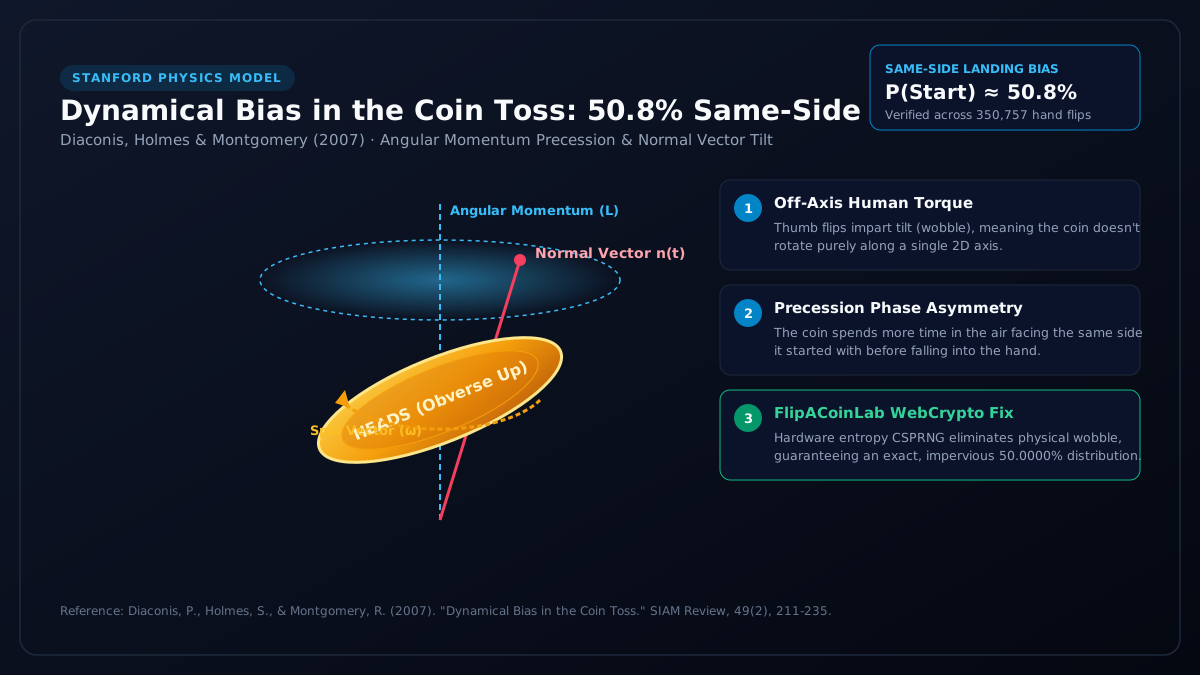
1. The Stanford Diaconis Precession Proof: Why Real Flips Are 50.8% Biased
For centuries, philosophers, statisticians, and sports leagues treated the coin toss as the quintessential archetype of pure, unbiased randomness. However, in a landmark 2007 paper titled "Dynamical Bias in the Coin Toss", Stanford University mathematicians Persi Diaconis, Susan Holmes, and Richard Montgomery demonstrated through high-speed stroboscopic cameras and mechanical flippers that physical coin tossing is deterministic physics rather than pure chance.
The researchers proved that because human thumbs never impart a purely perpendicular angular velocity vector, the coin experiences a continuous precession wobble around its normal axis. As a consequence, the coin spends approximately 50.8% of its flight trajectory oriented with the side that was facing upward when tossed.
P(Lands on Same Initial Face) ≈ 0.508 (50.8%) vs P(Opposite Face) ≈ 0.492 (49.2%)2. Spinning vs Flipping: The 80/20 Weight Imbalance Trap
While flipping a coin introduces a subtle ~1% bias, spinning a coin on a flat surface creates an extreme mechanical asymmetry.
On an American Lincoln penny, the obverse portrait of Abraham Lincoln contains significantly more metal relief volume than the reverse Memorial or Shield. This offsets the coin's center of mass toward the head side. When spun rapidly like a top, the heavier side is pulled downward by gravity, causing the penny to fall with the Tails face upward approximately 80% of the time.
3. Historical Empirical Coin Tossing Experiments
Throughout history, mathematicians have spent years tossing coins to test the Law of Large Numbers and Bernoulli trial distributions:
Comte de Buffon (1777)
Recorded 2,048 Heads (50.69%). Demonstrated initial convergence toward 50%.
Karl Pearson (1900)
Recorded 12,012 Heads (50.05%). Pioneered Pearson chi-squared goodness of fit testing.
John Kerrich (1940)
Tossed coins in a WWII internment camp, recording 5,067 Heads (50.67%) with empirical binomial confidence bands.
4. How WebCrypto CSPRNG Guarantees Exact 50.000% Probability
To eliminate thumb torque, atmospheric aerodynamic drag, and coin mass relief imbalances, FlipACoinLab utilizes the Web Crypto API (SubtleCrypto). Using CPU thermal noise and interrupt entropy pools, our engine samples uniformly distributed integers in the range $[0, 2^32-1]$.
Outcomes are partitioned symmetrically into exact binary halves ($x < 2^31$ yields Heads, $x \ge 2^31$ yields Tails), guaranteeing true mathematical fairness:
P(Heads) = P(Tails) = 0.5000000000000000 (Exact 50.0%)