















The Science of Fair Randomness: Physical vs. Cryptographic Coin Tossing
For millennia, humanity has relied on the coin toss as the quintessential arbiter of chance—from Roman magistrates invoking navia aut caput (ship or head) to determine property disputes, to modern sports officials deciding first possession. However, contemporary statistical physics and computational randomness have revolutionized our understanding of binary trials.
1. The Physical Mechanics of Coin Precession (The Diaconis Model)
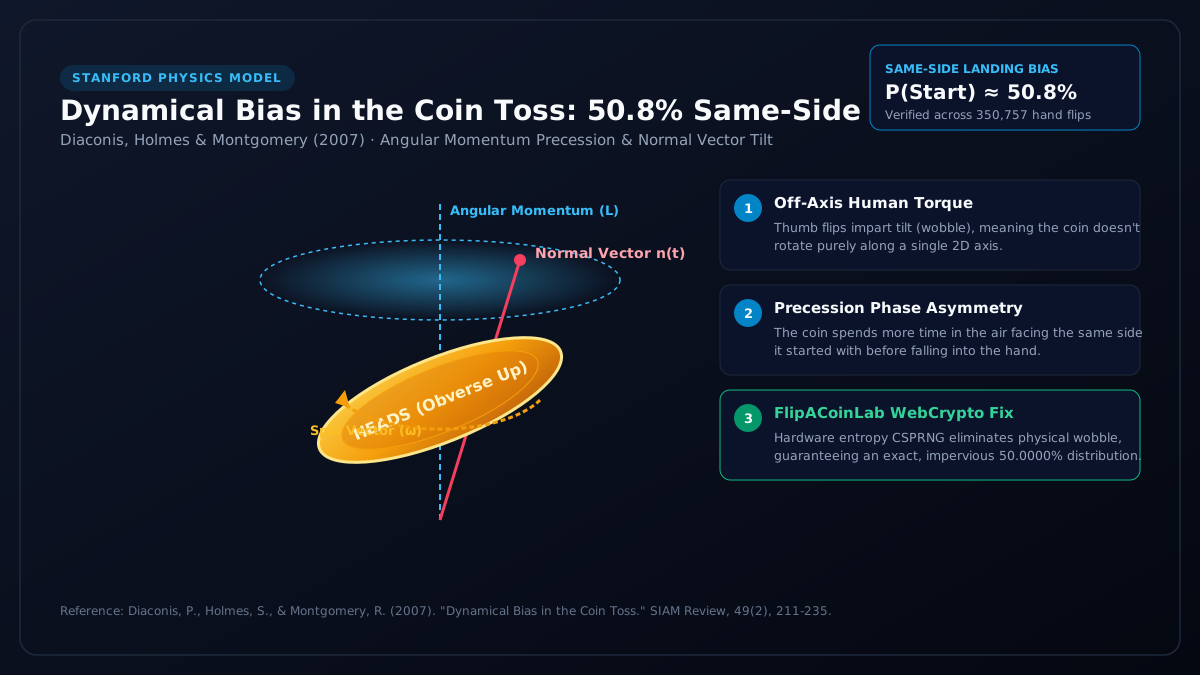
In a groundbreaking 2007 mathematical treatise published by Stanford statisticians Persi Diaconis, Susan Holmes, and Richard Montgomery, rigorous 3D motion-tracking analysis proved that physical coin tosses are not purely 50/50 random. Because human thumbs impart a continuous wobbling precession around the rotational axis, the coin spends approximately 50.8% of its flight time with the initial facing side upward.
Consequently, a coin launched with Heads facing up will land on Heads roughly 51 out of 100 times in physical environments. Furthermore, physical coin mass distribution can introduce edge bias; for instance, older minted coins with heavy relief engravings on the obverse face can exhibit subtle aerodynamic drag differentials.
Stanford Diaconis Precession Physics & 50.8% Same-Side Bias
2. Why Cryptographic CSPRNG Eliminates Physical Bias
FlipACoinLab eliminates physical torque, atmospheric turbulence, and thumb mechanics by generating binary trials through the Web Crypto API (SubtleCrypto). Using hardware entropy pools gathered from OS-level micro-interrupts and thermal noise, the generator produces integers in the range $[0, 2^32-1]$.
Because every outcome is mapped with exact symmetry ($x < 2^31$ yields Heads, $x \ge 2^31$ yields Tails), the mathematical probability of each outcome is exactly:
P(Heads) = P(Tails) = 0.500000000000 (Exact 50.0%)3. Debunking the Gambler's Fallacy
One of the most persistent cognitive biases in probability theory is the Gambler's Fallacy—the mistaken belief that if an event has occurred repeatedly in the past, the opposite outcome becomes more likely in the future. In an independent Bernoulli trial sequence, the conditional probability remains strictly invariant:
P(Next Flip = Heads | N Prior Tails) = P(Heads) = 50.0%A coin has no memory, no consciousness, and no physical obligation to "balance out" short-term variance. Over massive sample sizes ($N \ge 100,000$), the Law of Large Numbers ensures convergence toward a 50.0% ratio, but individual sequential flips remain unconditionally independent.