Coin Toss Probability Calculator
Solve exact binomial probability equations, compute cumulative thresholds ($P(X \ge k)$), and explore the mathematics of fair independent trials.
Binomial Probability & Mathematical Proof Engine
Solve exact theoretical binomial probabilities for any sequence of independent fair coin flips.
P(X = k) = C(n, k) · p^k · (1-p)^(n-k)The Gambler's Fallacy Interactive Proof
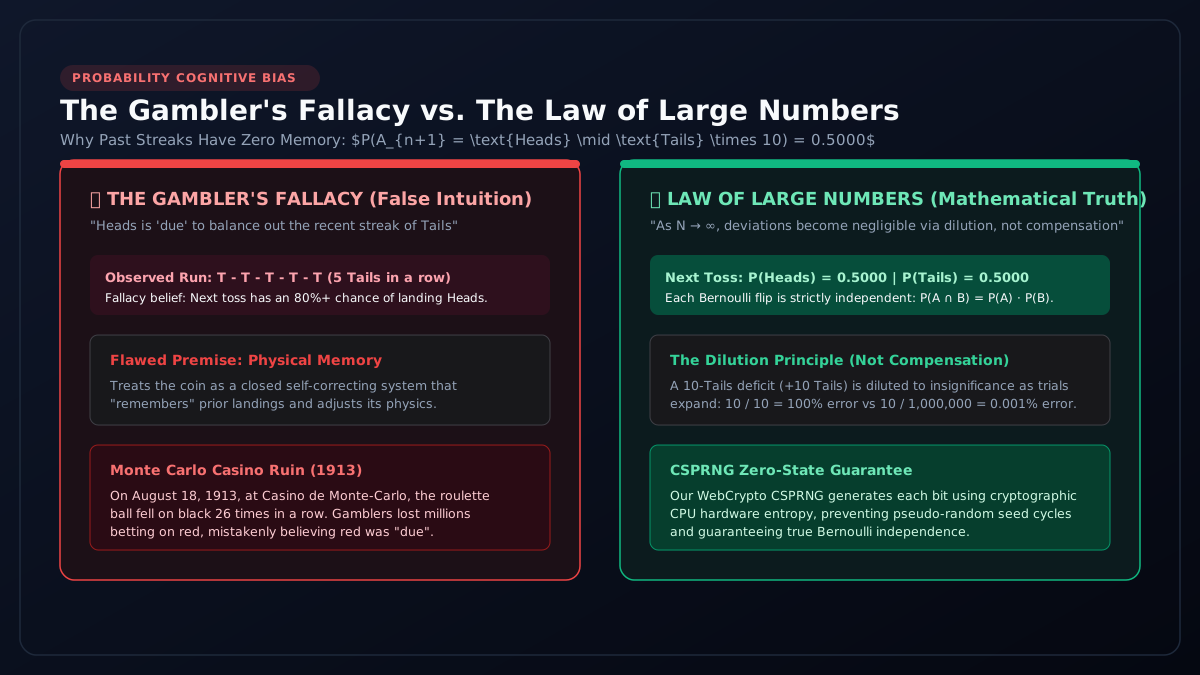
Does flipping 5 Tails in a row make Heads "due" on flip 6?
P(Flip 6 = Heads | 5 Prior Tails) = P(Heads) = 50.000%Coins possess no physical memory. Each coin toss is an independent event ($P(A \mid B) = P(A)$). The probability of landing heads on the next toss is always exactly 50.000%, regardless of past outcomes.
The Gambler's Fallacy vs. The Law of Large Numbers
Empirical Verification via Monte Carlo Simulation
Simulate thousands of fair binary trials off the main thread with live Binomial Distribution analysis.
Observed vs Theoretical Gaussian Bell Curve
Law of Large Numbers: As N → ∞, Observed Ratio → 0.500Normal Approximation to the Binomial Distribution

Related Probability & Simulation Silos
Frequently Asked Questions
What is the Binomial Probability formula for coin tosses?
The formula is P(X = k) = C(n, k) * p^k * (1-p)^(n-k), where n is the total number of coin tosses, k is the number of desired heads, p is the probability of heads (0.5 for a fair coin), and C(n, k) is the combination coefficient n! / (k!(n-k)!).
Why does the Gambler's Fallacy occur in coin flipping?
The Gambler's Fallacy arises from a misunderstanding of the Law of Large Numbers. People mistakenly believe that short-term sequences must balance out immediately. However, past tosses do not physically influence future flips—each trial is statistically independent.
What is the probability of a streak of 10 heads?
The probability of getting 10 heads in 10 consecutive flips is (1/2)^10 = 1/1,024 = 0.0976%.